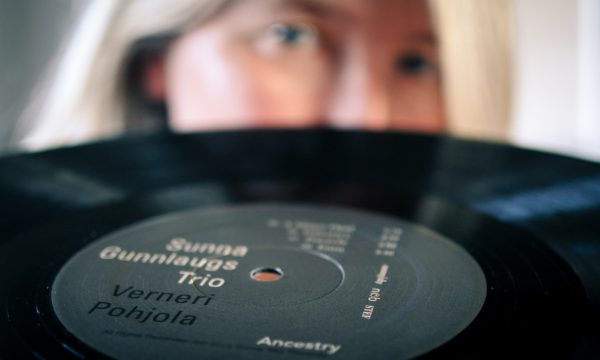
Sunna Gunnlaugs plays piano the way Iceland feels — spacious, luminous, alive with quiet drama. But her music carries another fingerprint, too: twelve years in New York, where she came of age in the late-night sessions and listening rooms that shaped a generation of jazz musicians. Critics have called what emerges from that double inheritance "Nordic-Americana" — European elegance and a fiery New York drive in the same breath.
She didn't grow up planning any of it. Raised on Seltjarnarnes, a small peninsula just outside Reykjavík, she started on the organ at her mother's encouragement — partly because the piano, with its associations of stiff classical recitals, seemed boring. The organ let her play anything: the Beatles, polkas, Strauss. Jazz wasn't on her radar at all. She traced her way into it through liner notes — wondering who Quincy Jones was, then Count Basie, then Herbie Hancock. The turning point was a gift from her brother: a Bill Evans live trio record called You're Gonna Hear From Me. Something about the way three musicians could think together captivated her completely.
Even then, music as a career wasn't the plan. She'd assumed she would study engineering or mathematics, and was twenty-three before she finally admitted that nothing else interested her the way the piano did. There was also the matter of stage fright — she used to be terrified of performing, unable to eat before recitals — until jazz, with its built-in communion of playing with others, changed that for her.
In 1993 she made her way to William Paterson College in New Jersey, fifteen minutes from Manhattan. The city did its work: the Village Vanguard, Bradley's, late nights filled with inspiration. It was at William Paterson that the guitarist Kenny Burrell told her – to her bewilderment at the time – that her Icelandic heritage would find its way into her playing. She wouldn't recognize what he meant for years. After graduating in 1996 she moved to Brooklyn and made her debut, Far Far Away, with bassist Dan Fabricatore and drummer Scott McLemore – who would later become her husband. The Village Voice called her an "impressive newcomer." She began appearing at Cornelia Street Café and the Knitting Factory, and her writing began to outgrow the trio.
"Such timeless virtues as lyricism and grace… elegantly bridges soul-searching passages with uncluttered swing."
— The Washington Post
The quartet records that followed — Mindful (2000) and Songs from Iceland, both recorded in a single day with saxophonist Tony Malaby and bassist Drew Gress — drew critical attention on both sides of the Atlantic. Mindful landed on the Virginian Pilot's top ten albums of the year, and her 2010 release The Dream would later reach number two on the Canadian jazz radio charts.
"Proof that jazz is as much a part of the picture as the pop of Björk or Sigur Rós."
— Time Out New York
In 2005, she and McLemore decided to leave New York and return to Iceland to start a family. The move changed the music in ways she didn't entirely anticipate – it became calmer, more open, full of the space the new life made room for. It also saw the beginning of one of the most enduring partnerships in European jazz. With bassist Þorgrímur Jónsson and McLemore, the Sunna Gunnlaugs Trio premiered Long Pair Bond at the 2011 London Jazz Festival and has been working together ever since – long enough now to read silence as fluently as sound. Across Long Pair Bond, Distilled, Ancestry (recorded with Finnish trumpeter Verneri Pohjola at the Sibelius Academy) and 2023's Becoming, the conversation has only deepened. A sixth trio album, Go Round Merry recorded in early 2025, premiered at the Reykjavík Jazz Festival that August.
"Icelandic folk melodies and brooding soundscapes… an unhurried Bill Evans-like swing."
— Jon Newey, Jazzwise
The cinematic dimension of her writing has carried over into film and television, with scores for Reykjavík, Bíóland, and Icelandic TV, including an Edda nomination in 2022. It has also carried her to performances at JazzAhead, the Kennedy Center's Nordic Cool festival, the London Jazz Festival, Rotterdam, Belgrade, Montreal, Vancouver, Tokyo. With fifteen albums and counting on her own label, Sunny Sky Records. Every record has been nominated for the Icelandic Music Awards; she was named Performer of the Year in 2015 and again in 2019.
Coming home also meant looking around. When Sunna returned to Iceland, she was struck by how few women were on the jazz scene — and as co-director of the Reykjavík Jazz Festival, she noticed they weren't even applying for slots. Rather than treat that as a footnote, she founded Freyjujazz in 2017, a concert series and movement championing women in jazz. Its first year hosted twenty-five concerts featuring women from Iceland, Norway, Germany, Hungary, and the United States, and it was named Event of the Year at the Icelandic Music Awards. She has served as Artistic Director of the Reykjavík Jazz Festival, Vice President of the European Jazz Network, and director of the Jazz í Salnum concert series at Salurinn Concert Hall in Kópavogur — helping shape the future of the genre across the continent.
The piano remains the still center of it all. On stage, on screen, or in the quiet of her Kópavogur studio, Sunna keeps returning to the same questions — how to find grace inside motion, how to let space speak, how to make music that breathes.